









 Biswajoyee Barman
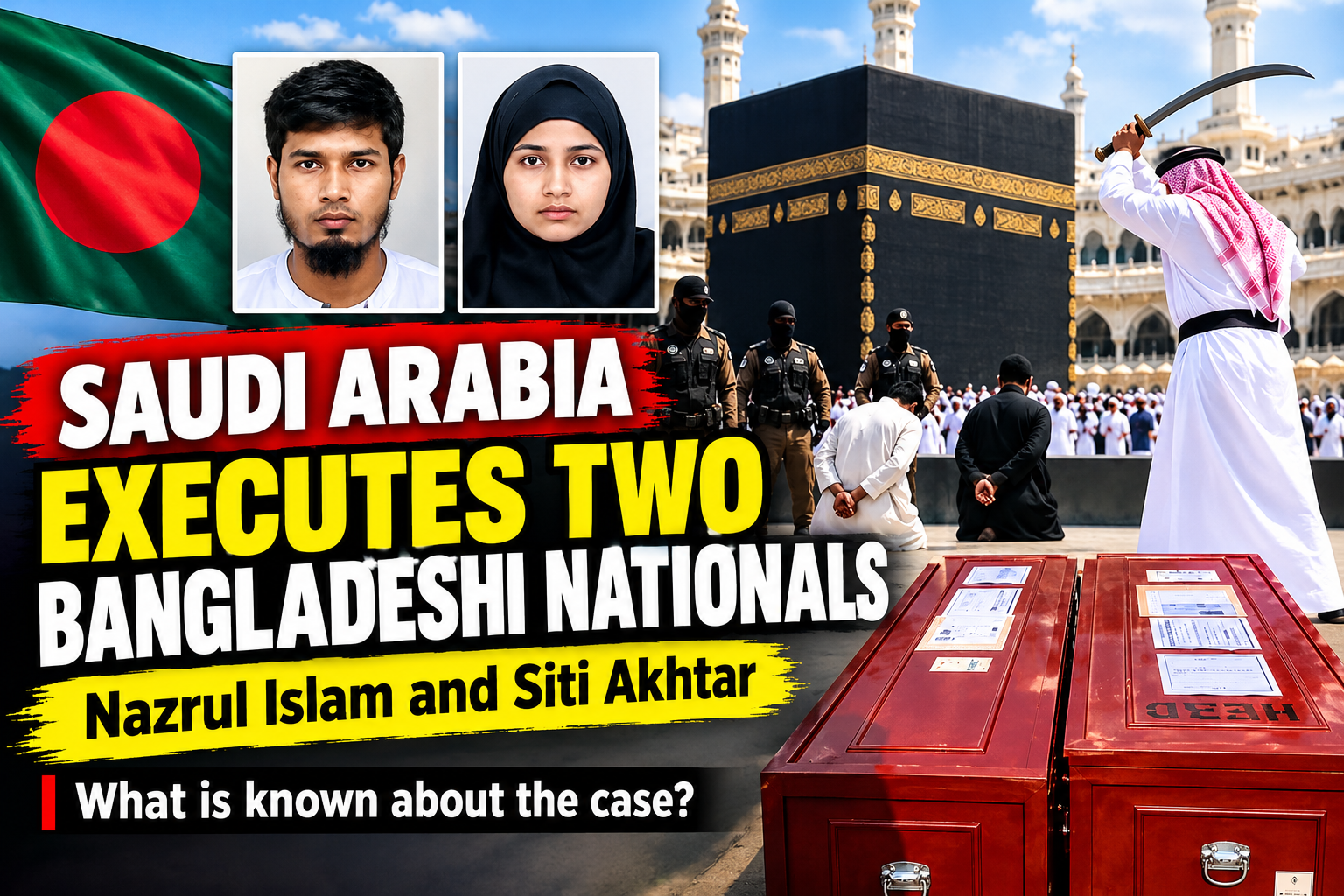
Saudi Arabia Executes Two Bangladeshis: What Is Officially KnoBangladeshi Nationals Executed in Saudi Arabiawn About the Nazrul Islam and Siti Akhtar Case
Saudi Arabia Executes Two Bangladeshis After Court Verdict, Says Official Statement
Saudi Arabia has confirmed the execution of two Bangladeshi nationals in the Makkah region, a case that has attracted significant international attention and widespread discussion on social media.
According to an official statement issued by Saudi authorities, the two individuals were identified as Nazrul Islam Abdul Basir and Siti Akhtar. The executions were reportedly carried out on 14 October 2026 after the country’s judicial process was completed.
The incident has generated strong reactions in Bangladesh and among overseas Bangladeshi communities because of the seriousness of the punishment and the questions surrounding diplomatic notification before the executions.
Saudi Authorities’ Official Statement
According to the Saudi Ministry of Interior, the two Bangladeshi nationals were convicted after a criminal case related to an alleged immoral act inside a mosque in the holy city of Makkah.
The ministry stated that:
- Security authorities arrested the two suspects.
- The case was investigated.
- Prosecutors filed formal charges.
- A competent court found both guilty.
- The death sentence was later upheld by higher judicial authorities.
- A Royal Order authorized the execution before it was carried out on 14 October 2026.
Saudi officials stated that the punishment was imposed under Ta’zir, a discretionary punishment under Saudi law, citing the seriousness of the offence and the sanctity of the mosque and the holy city.
Social Media Claims vs Official Information
Following the executions, many posts began circulating on Facebook, TikTok, WhatsApp and other platforms.
Some posts claimed:
- the two were husband and wife,
- they had travelled for Hajj,
- they were on their honeymoon,
- the incident involved only a forehead kiss,
- they had an eight-year-old daughter.
However, these claims have not been confirmed in the official Saudi statement.
Reports from Bangladeshi media have also shown differences regarding several details of the case. Therefore, readers should be careful before sharing viral social media posts that present unverified information as fact.
Bangladesh Government Seeks Explanation
The executions also led to diplomatic concern.
According to reports, Bangladeshi officials said that the country’s Consulate General in Jeddah and the Ministry of Foreign Affairs were not informed in advance about the executions.
The matter reportedly prompted Bangladesh to seek an official explanation from Saudi Arabia regarding:
- the legal proceedings,
- the judicial process,
- the lack of prior diplomatic notification,
- and other details surrounding the executions.
Officials are reportedly waiting for a formal response before deciding on further diplomatic steps.
Why Has the Case Become So Widely Discussed?
The case has become one of the most talked-about international news stories because it combines several sensitive issues, including:
- Saudi Arabia’s criminal justice system,
- capital punishment,
- protection of holy places,
- diplomatic communication,
- and the rights of migrant workers abroad.
At the same time, the incident has also highlighted how quickly misinformation can spread online when official information is limited.
Bangladesh Seeks Answers After Saudi Arabia Executes Two Nationals
The executions have also triggered a diplomatic response from Bangladesh. According to Bangladeshi officials, neither the Ministry of Foreign Affairs nor the Bangladesh Consulate General in Jeddah received prior notification that the two citizens were facing imminent execution. The government has formally requested detailed information from Saudi Arabia regarding the legal proceedings, the charges, the court’s decision, and the reasons why standard diplomatic notification procedures were not followed before the executions took place. Bangladeshi authorities say they first learned about the executions through media reports before receiving official confirmation. The issue has become an important diplomatic matter, with Dhaka awaiting a formal response from Riyadh before deciding on any further action, including the repatriation of the bodies.
Questions Raised Over Consular Notification
One of the biggest concerns raised after the incident is the lack of advance communication with Bangladesh’s diplomatic mission. Officials have indicated that if they had been informed earlier, they might have been able to provide legal assistance, seek clarification about the judicial process, or communicate more effectively with the families of the accused. Reports suggest that the names of the two Bangladeshis appeared on lists of detained citizens shared with Bangladeshi authorities, but information indicating that they had received death sentences was reportedly absent. This has led Bangladeshi officials to question why such critical information was not communicated before the executions were carried out. The issue has now become a central point in discussions between the two countries.
Families Left in Shock Following the Executions
The families of Nazrul Islam Abdul Basir and Siti Akhtar have expressed grief and disbelief after learning about the executions. According to media reports, relatives said they were unaware that the judicial process had reached its final stage. Some family members reportedly stated that they had spoken with their loved ones while they were in detention but were never informed that the executions were imminent. Nazrul’s family has requested that his body be returned to Bangladesh so they can perform his final rites. Siti Akhtar’s relatives have also appealed to the authorities for more information regarding her case and the legal proceedings that led to the sentence. Their emotional statements have attracted widespread sympathy on social media across Bangladesh.
What Saudi Arabia Officially Said About the Case
Saudi Arabia’s Ministry of Interior stated that both individuals were convicted after judicial proceedings related to an alleged “indecent” or “immoral act” inside a mosque in Makkah. The ministry did not publicly describe the exact nature of the act in detail. Instead, the official statement emphasized that the punishment reflected the seriousness of violating the sanctity of a holy place. The case was reportedly reviewed through multiple levels of the Saudi judicial system before the sentences were upheld and implemented under a Royal Order. Because the official statement does not provide additional factual details, claims circulating online about exactly what occurred should be treated with caution unless independently verified.
What Is Ta’zir Punishment Under Saudi Law?
One of the most discussed aspects of this case is the legal concept of Ta’zir, under which Saudi authorities said the death sentences were imposed. In Saudi Arabia, Ta’zir refers to a category of discretionary punishment where judges have the authority to determine an appropriate sentence based on the seriousness of an offence when no fixed punishment is prescribed under Islamic law. Saudi officials stated that the court considered the alleged offence especially serious because it was said to have taken place inside a mosque in the holy city of Makkah, making it a violation of the sanctity of both the place and the occasion. However, the Saudi Ministry of Interior did not publicly disclose the exact details of the alleged act, and therefore many descriptions circulating on social media cannot be independently verified. Legal experts note that Ta’zir decisions depend on judicial interpretation, which means punishments can vary depending on the circumstances and the court’s findings.
Social Media Claims Continue to Spread
Since news of the executions became public, thousands of posts have appeared across Facebook, TikTok, YouTube and WhatsApp claiming to explain what happened. Some posts allege that the two individuals were husband and wife, while others claim they were only engaged or were unrelated. Several viral posts even state that they were on their honeymoon or that the alleged incident involved only a kiss. None of these details have been confirmed in the official Saudi statement. Because of these conflicting narratives, readers should rely on verified reporting and official announcements rather than viral social media posts. Publishing or sharing unverified claims as established facts can create misinformation and unnecessary confusion, especially in sensitive international legal cases.
Timeline of the Case
According to reports based on official documents and media coverage, Nazrul Islam Abdul Basir and Siti Akhtar had been working in Saudi Arabia for several years before their arrest. They were reportedly detained in 2023, after which investigations and court proceedings began. The case then moved through Saudi Arabia’s judicial system over a period of more than three years. Higher courts later upheld the verdict, and a Royal Order authorized the implementation of the sentence. On 14 October 2026, the executions were carried out in the Makkah region. Bangladesh says it was not informed beforehand and only learned of the executions after they had already taken place, prompting diplomatic protests and requests for detailed information about the judicial process.
International Attention and Diplomatic Response
The executions have received significant international media attention because they involve two foreign nationals and raise broader questions about consular notification and legal transparency. Bangladesh has officially asked Saudi Arabia to explain why its embassy and consulate were not informed before the executions took place. Officials have also requested copies of the court judgments and other legal documents related to the case. As of the latest available reports, Bangladesh was still waiting for a formal response from Saudi Arabia. The issue has become an important diplomatic matter between the two countries while families continue to seek further information about the case.
International Attention Over Saudi Arabia Executes Two Bangladeshis Case
The execution of two Bangladeshi nationals in Saudi Arabia has attracted attention beyond Bangladesh because the case involves several sensitive issues, including foreign workers’ rights, capital punishment, legal procedures, and communication between governments. Many international observers have focused on how migrant workers facing serious criminal charges receive legal support while living abroad. Countries around the world generally rely on diplomatic missions to assist their citizens during major legal proceedings, especially when a case involves the possibility of the death penalty.
For millions of migrant workers who live and work outside their home countries, access to legal information and consular assistance is considered an important issue. The case of Nazrul Islam Abdul Basir and Siti Akhtar has therefore renewed discussions about how foreign nationals are informed about court decisions and final sentences in another country.
Importance of Legal Support for Migrant Workers
Millions of people from Bangladesh, India, Pakistan and other Asian countries work in Middle Eastern countries every year. These workers often leave their families behind in search of better economic opportunities. However, when a migrant worker becomes involved in a legal case, language barriers, unfamiliar laws and limited financial resources can create additional difficulties.
Legal experts often advise migrant workers to understand the laws of the country where they are working. Rules and social expectations can differ significantly from one country to another. Actions that may not be considered serious in one place can carry severe consequences in another country.
The Saudi Arabia case has highlighted the importance of:
- Understanding local laws before travelling abroad.
- Maintaining proper communication with family members.
- Seeking legal assistance when facing criminal allegations.
- Staying connected with embassy or consulate services.
Saudi Arabia’s Strict Laws and Public Conduct Rules
Saudi Arabia follows a legal system influenced by Islamic law and has strict regulations regarding public behaviour, especially in religious areas. The holy cities of Makkah and Madinah have additional significance because millions of Muslims visit these places every year for religious purposes.
Saudi authorities have repeatedly stated that maintaining the dignity and security of holy places is a major responsibility. Any activity considered disrespectful or harmful to public morality can result in serious legal consequences.
In this case, Saudi officials stated that the court considered the alleged offence serious because it involved a mosque in Makkah. The authorities said the punishment was connected to the seriousness of the offence and the importance of protecting the sanctity of the location.
However, the exact details of the incident remain limited in public statements. Therefore, claims spreading online about specific actions or personal relationships between the two individuals should not be accepted without confirmation from reliable sources.
Rumours and the Need for Responsible Sharing
After major incidents, especially those involving death sentences, social media platforms often become filled with emotional posts and unverified information. People sometimes share content quickly without checking whether the information comes from an official source.
In the Nazrul Islam Abdul Basir and Siti Akhtar case, several different versions of the story circulated online. Some posts presented personal details about their family background, marriage status and the circumstances of the incident. However, many of these details have not been officially confirmed.
Responsible reporting requires separating:
Confirmed Information:
- Saudi authorities confirmed the execution.
- The individuals were identified as Bangladeshi nationals.
- The case involved an alleged immoral act according to Saudi authorities.
- The sentence followed a court process.
Unverified Claims:
- Personal family details shared online.
- Claims about the exact nature of the incident.
- Information without confirmation from authorities or reliable media.
Readers should always verify information before sharing sensitive news.
Lessons for Bangladeshis Working Abroad
The case has also created awareness among Bangladeshi citizens planning to work overseas. Every year, thousands of Bangladeshis travel abroad for employment opportunities. Before travelling, workers should learn about the laws, culture and regulations of their destination country.
Some important points include:
1. Know the Local Laws
Every country has its own legal system. Migrant workers should understand rules related to public behaviour, employment, financial activities and personal conduct.
2. Keep Important Documents Safe
Workers should keep copies of:
- Passport
- Work permit
- Employment contract
- Identification documents
- Emergency contact details
These documents can become important during emergencies.
3. Stay Connected With Family
Regular communication with family members can help in difficult situations. Families should know the workplace location and employer details of their relatives working abroad.
4. Contact Embassy or Consulate When Needed
Bangladesh has diplomatic missions in different countries to provide assistance to citizens. Workers facing legal problems should contact their embassy or consulate as early as possible.
Frequently Asked Questions (FAQ)
1. Who were Nazrul Islam Abdul Basir and Siti Akhtar?
Nazrul Islam Abdul Basir and Siti Akhtar were identified by Saudi authorities as Bangladeshi nationals who were executed in the Makkah region after a court verdict.
2. When did Saudi Arabia execute the two Bangladeshis?
According to reports and Saudi authorities, the execution took place on 14 October 2026 in the Makkah region.
3. Why were they sentenced to death?
Saudi authorities stated that they were convicted for an alleged immoral act inside a mosque in Makkah. The exact details of the incident were not fully disclosed publicly.
4. Did Bangladesh know about the execution before it happened?
According to Bangladeshi officials, the government and diplomatic mission were not informed in advance about the execution.
5. Were the two people husband and wife?
Several social media posts claimed different things about their relationship, but this information has not been officially confirmed.
6. What is Ta’zir punishment?
Ta’zir is a category of discretionary punishment where judges determine the sentence based on the circumstances and seriousness of an offence under the legal system.
7. Why is the case being discussed internationally?
The case has drawn attention because it involves foreign nationals, capital punishment, diplomatic communication and migrant worker rights.
8. Should people believe every social media post about this case?
No. Sensitive news should always be checked through official statements and reliable news sources before sharing.
Conclusion: Need for Verified Information and Legal Awareness
The execution of Bangladeshi nationals Nazrul Islam Abdul Basir and Siti Akhtar in Saudi Arabia has raised important questions about legal procedures, diplomatic communication and the challenges faced by migrant workers abroad.
While Saudi authorities have provided information about the court decision and execution, many details circulating online remain unverified. In such sensitive cases, spreading rumours can create confusion and cause additional pain for affected families.
The incident serves as a reminder that people working abroad should understand local laws, respect regulations and remain aware of available legal support systems.
For readers, the most important lesson is to depend on verified information rather than viral social media claims. Accurate reporting and responsible sharing help ensure that serious international issues are discussed with facts and fairness.
Disclaimer: This article is based on publicly available reports and official statements. Some details circulating on social media have not been independently verified.